Labour market test in Bulgaria: what actually replaces it
Bulgaria has no procedure called a labour market test. A headcount cap and a written justification do that work, and thirteen refusal grounds decide if you qualify.
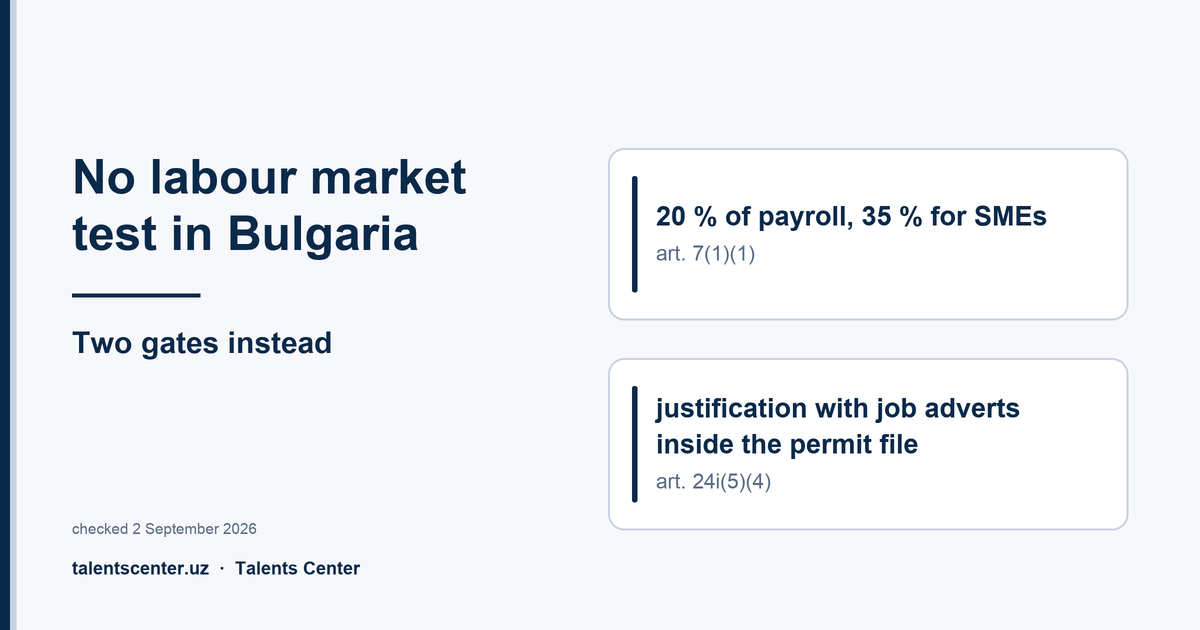
No procedure in Bulgarian law is called a labour market test. The phrase comes from other countries and from English-language summaries, and searching both migration acts for it returns nothing. Two other things do the job it describes, and both are about the employer rather than the worker.
The first is a cap on how many third-country nationals your payroll may carry. The second is a written justification that goes inside the permit file. This page sets out what each one asks for, then lists the grounds on which the Employment Agency refuses access, and the duties that start on the worker's first day.
All article numbers on this page were read on 2 September 2026 in three current texts: the Labour Migration and Labour Mobility Act, its Implementing Rules, and the Foreigners in the Republic of Bulgaria Act.
The labour market test in Bulgaria: two gates instead of one
Third-country nationals hired under an employment relationship in the previous twelve months may not exceed 20 per cent of the average payroll headcount, or 35 per cent for small and medium enterprises within the meaning of the Small and Medium Enterprises Act. Pay and working conditions offered must be no less favourable than those for Bulgarian nationals in the same category of labour. And the person must hold specialised knowledge, skills and professional experience that the post requires.
The advertisements were struck out of one act in 2021 and left standing in the other.
The second gate is the one people mean when they say "test". Art. 24i(5)(4) of the Foreigners in the Republic of Bulgaria Act requires a justification for labour market access, in which the employer does three things: states the facts and circumstances that make hiring a foreign worker necessary, submits copies of the job advertisements placed in local and national media and on the internet, and gives reasons for refusing to hire a Bulgarian, EU, EEA or Swiss national, or a person with equivalent rights, who met the requirements in that advertisement.
That is a market test in substance — in substance only. It has no separate file number, no separate fee and no separate decision. It travels inside the permit application and it is read by the same official.
The half that was repealed, and the half that was not
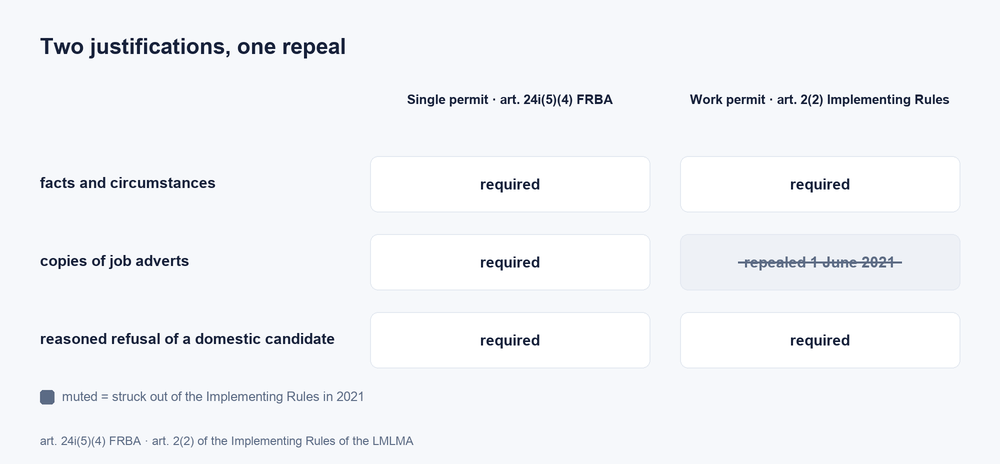
Bulgaria has two justifications, in two different acts, and they stopped being identical on 1 June 2021.
What the justification must contain
Single permit, art. 24i(5)(4) Foreigners Act
Work permit for posted staff, art. 2(2) Implementing Rules
Facts and circumstances requiring the hire
required
required
Copies of job advertisements
required
repealed, in force 1 June 2021
Reasoned refusal of an available domestic candidate
required
required
The advertisement requirement was struck out of the Implementing Rules by the 2021 amendment. It was left standing in the Foreigners Act, where the single permit lives. Since the single permit is the route almost every employer uses, the practical answer is that you still advertise, and you still keep the copies.
This is worth stating plainly, because summaries in English usually pick one of the two acts and describe it as the whole picture. Read one way, Bulgaria dropped its labour market test in 2021. Read the other way, it never had one. Both readings will cost you a file.
Where the cap does not apply at all
Art. 15(2) of the Labour Migration Act lifts the headcount condition, and only that condition, for four groups inside the single permit route: employment arising from an international treaty to which Bulgaria is a party, visiting lecturers and teachers at Bulgarian schools and universities, performing artists whose hiring the Ministry of Culture has confirmed as of interest, and athletes and coaches confirmed by the national sports federations.
Three whole regimes sit outside the cap as well. It does not apply to the EU Blue Card under art. 17(1), and it does not apply to seasonal employment under art. 24(1) and art. 25(4). The other two conditions of art. 7(1) stay in place in every one of these cases. Pay and conditions still have to match, and the qualification still has to be real.
The thirteen grounds, and how many of them are about your company
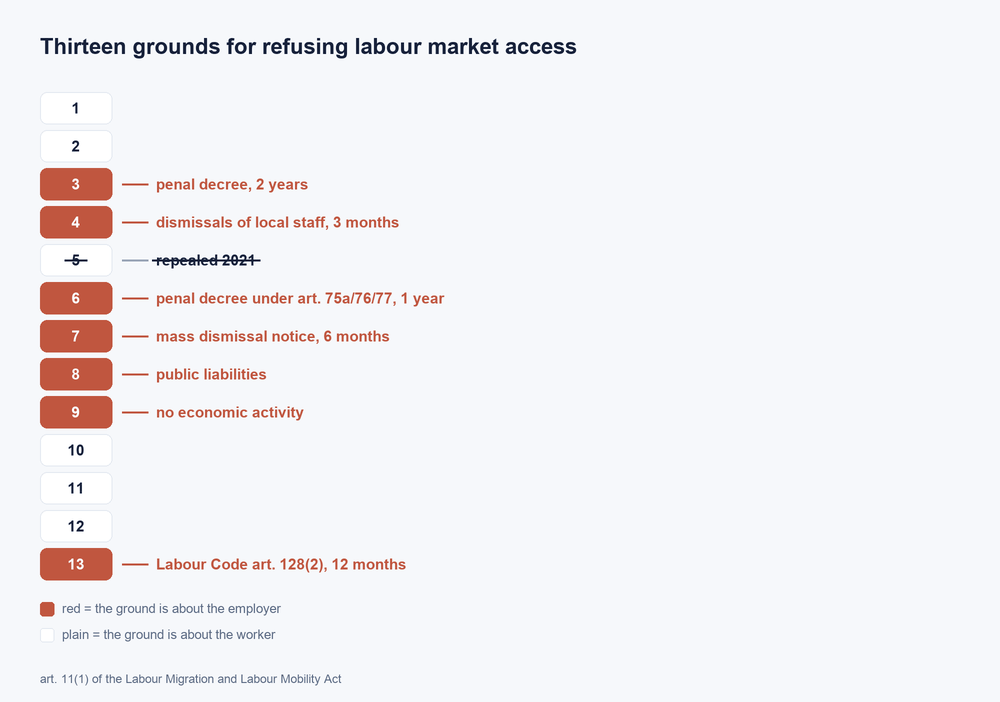
Art. 11(1) lists the grounds on which the Executive Director of the Employment Agency refuses access to the labour market. There are thirteen, one of which, point 5, was repealed in 2021. Seven of them describe the employer, not the applicant.
A penal decree that came into force in the previous two years for using the labour of a foreigner without access to the market, or for hiring an illegally staying foreigner.
Dismissal, on the company's own initiative, in the last three months, of Bulgarian, EU, EEA or Swiss nationals or persons with equivalent rights who could have filled the post now being offered to a third-country national.
A penal decree that came into force in the previous year under art. 75a(2), 76(2) and (3), or 77(1) and (2) of the same act.
A mass dismissal notice filed under art. 24 of the Employment Promotion Act, in the previous six months, for the same categories, professions and qualification levels.
Public liabilities established by an effective act of a competent authority, unless payment has been deferred or rescheduled.
No economic activity, or activity terminated through liquidation or insolvency.
A penal decree under art. 128(2) of the Labour Code in the previous twelve months.
Seven of the thirteen describe the company rather than the candidate, and five of them look back over a fixed number of months.
Several of these the Agency establishes without asking you. Art. 3 of the Implementing Rules has it request information from the National Revenue Agency about the company's public liabilities and from the General Labour Inspectorate about effective penal decrees for the breaches listed in art. 11, and art. 3(2) applies the same two requests to the opinion under art. 15(1), which is the single permit. The mass dismissal notice needs no request at all: it was filed with the Employment Agency in the first place. The acts do not say how many of the thirteen grounds these checks cover, and neither will we.
Read the list before you promise a start date to anyone. Three of the seven lines are about the last three, six and twelve months of your own company's record, which means a refusal today can be the consequence of a decision taken in the spring. If one of them is true this quarter, the problem is your calendar and not your supplier, and we would rather tell you that before a group is selected than after.
Employer obligations after the worker starts
The permit is the beginning of the duties, not the end of them. Two acts hold them, and neither one reminds you.
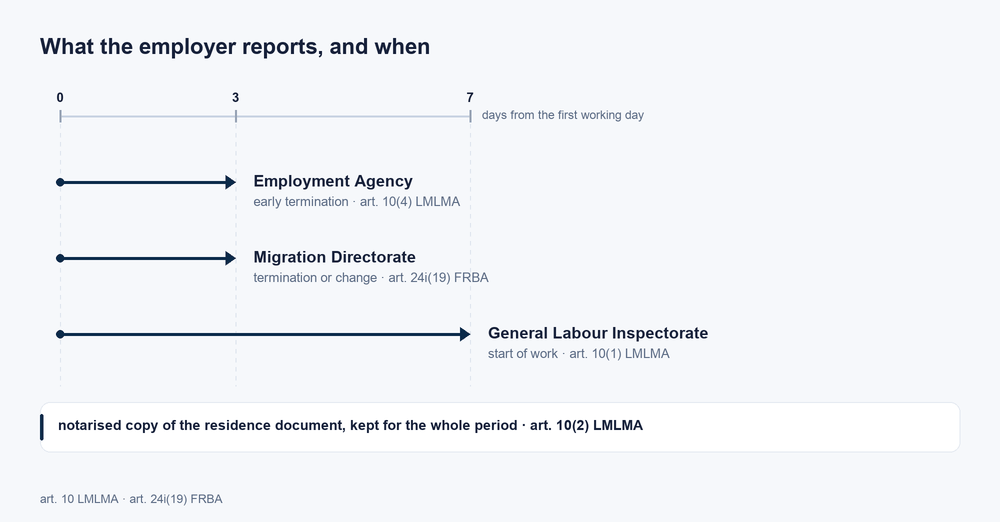
Art. 10 of the Labour Migration Act gives you seven days from the actual start of work to notify the General Labour Inspectorate in writing. For the whole period of employment you keep a notarised copy of the person's valid residence document. If the employment ends early, you notify the Employment Agency in writing within three days.
Art. 24i(19) of the Foreigners Act adds the Migration Directorate to the list. You notify it within three days of any change affecting the admission criteria during the procedure, and within three days of terminating the employment relationship. Then comes the sentence employers read twice: the right of residence ends on the date the employment relationship ends. A dismissal in Bulgaria does more than end a job. It ends the person's legal stay, and the clock on that starts the same day.
Two of the three deadlines are three days long, and both start on the day the contract ends.
Seasonal employment adds three duties that no other route carries, and they are paid for by the employer. They are set out on the page about hiring for the season, because they only make sense next to the seasonal calendar.
Where this page stops
A search for the labour market test in Bulgaria lands here, and this page answers the question behind it: whether your company qualifies, and what it takes on. It says nothing about how the file travels, what the deadlines are, or which documents come from the worker's home country. That is a different question with a different answer, and it is set out step by step on the page about the permit route and its deadlines.
Run the list of seven against your own last twelve months before you look for a supplier. If none of them applies, write to us with the job, the quarter you want people on site and the town, and our reply will say which of the duties above no supplier can take over for you. That reply comes within 48 hours in business hours. The half of the work that happens before any of this is what the sending side prepares.
FAQ
Questions and answers
Does Bulgaria have a labour market test?
Not under that name. Bulgarian law has no separate procedure called a labour market test, no separate file and no separate decision. Two requirements do the same job: the cap in art. 7(1)(1) of the Labour Migration and Labour Mobility Act on how many third-country nationals a payroll may carry, and the written justification in art. 24i(5)(4) of the Foreigners Act, which travels inside the single permit application.
Do I still have to advertise the job before hiring a foreign worker?
For the single residence and work permit, yes. Art. 24i(5)(4) of the Foreigners Act requires copies of the advertisements placed in local and national media and on the internet, together with reasons for refusing a Bulgarian, EU, EEA or Swiss candidate who met those requirements. The same requirement was repealed from the Implementing Rules of the Labour Migration Act on 1 June 2021, which is why English summaries disagree with each other.
How many foreign workers may my company employ in Bulgaria?
Third-country nationals hired under an employment relationship in the previous twelve months may not exceed 20 per cent of the average payroll headcount, or 35 per cent for a small or medium enterprise. The cap is lifted entirely for the EU Blue Card and for seasonal work, and it does not apply to four groups listed in art. 15(2) of the Labour Migration Act.
What must an employer report after a foreign worker starts?
Three notifications. The General Labour Inspectorate within seven days of the actual start of work, the National Employment Agency within three days if the employment ends early, and the Migration Directorate within three days of terminating the contract. You also keep a notarised copy of the person's valid residence document for the whole period of employment.
Get in touch
Let's discuss your staffing needs
Leave a request and we'll get back to you within 48 hours during business hours — or reach us directly on Telegram or by phone.