EU Blue Card in Bulgaria: when it fits, and when it does not
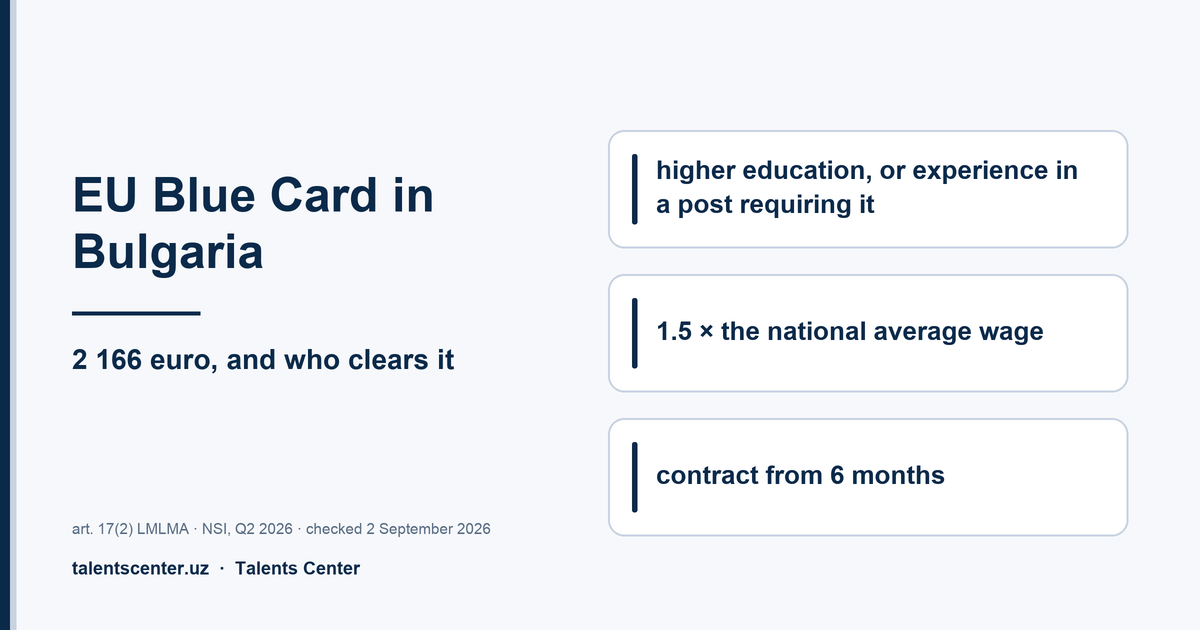
The Blue Card lifts the headcount cap, and its salary threshold is 2 166 euro gross a month. That is 1.83 times construction pay and 2.42 times hotel pay in Bulgaria.
The EU Blue Card in Bulgaria for employers has one attraction and one obstacle. The attraction is that the headcount cap on third-country nationals does not apply to it. The obstacle is the first of its three conditions: higher education, or long experience in a post that requires higher education. For a welder, a driver or a bricklayer, that condition ends the conversation.
The salary threshold ends it a second time. It is set at 1.5 times the national average wage, and the national average is well above what the trades pay. This page puts real numbers on both, and then names the document that works instead.
Salary data on this page was taken on 2 September 2026 from the National Statistical Institute release for the second quarter of 2026. The three conditions, the validity and the procedure were read the same day in the acts they are cited from.
The EU Blue Card in Bulgaria: three conditions for employers
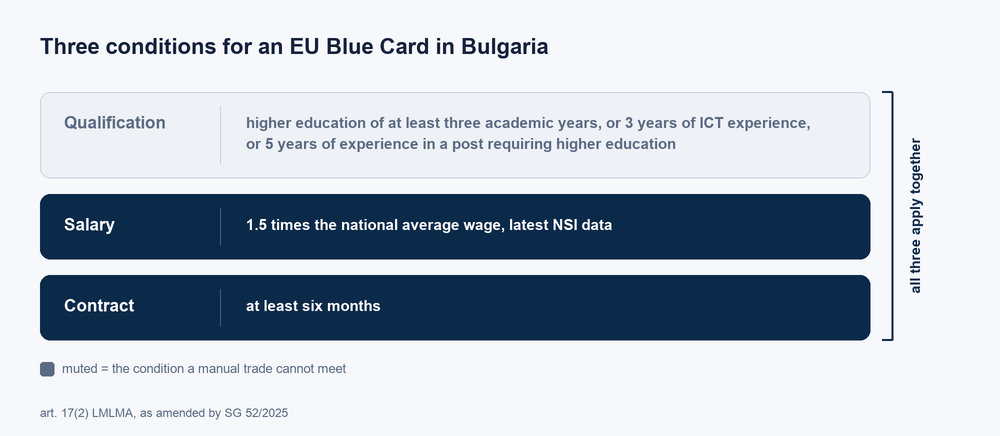
Art. 17(2) of the Labour Migration and Labour Mobility Act sets them, and they apply together.
Condition
What the act asks for
Qualification
higher education from a course of at least three academic years; or, for managers and specialists in information and communication technologies, at least three years of relevant experience within the last seven in a post requiring higher education; or, for any other post, at least five years of such experience
Salary
gross pay in the contract at least 1.5 times the national average wage, according to the latest published data of the National Statistical Institute for the 12 months before the contract is signed
Contract
a term of at least six months
The three work together, and the first one is what rules out the trades.
Read the qualification row slowly. Experience counts only where it was gained in a post that itself required a completed higher education. Five years on a site or behind a wheel is not that experience, however well documented it is, and no amount of certificates converts it.
The two experience routes were both rewritten in 2025, and the three-year route was narrowed to a named part of the occupational classification: group 133, managers in information and communication technologies, and sub-class 25, ICT specialists. Everything outside those two codes falls back on five years.
What 1.5 times the average actually means in euro
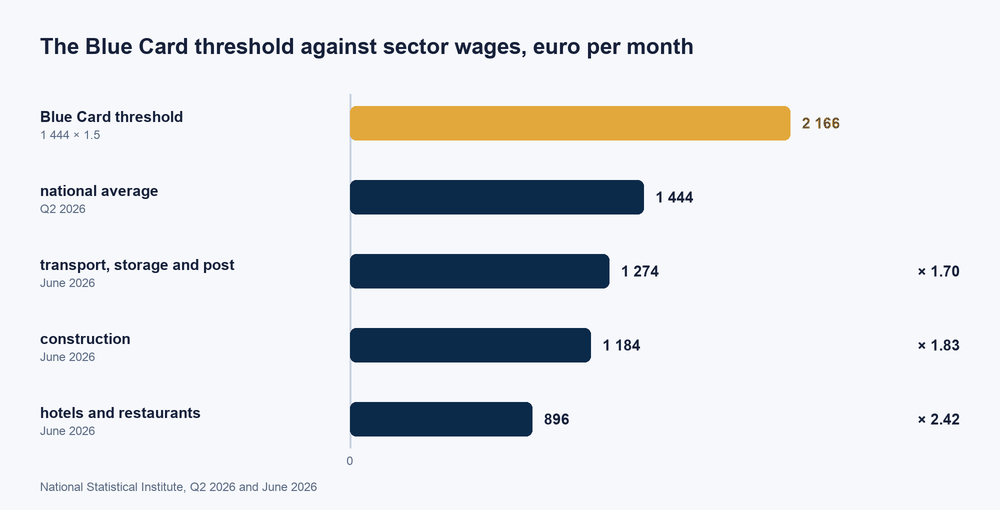
The National Statistical Institute puts the average monthly wage in the second quarter of 2026 at 1 444 euro. One and a half times that is 2 166 euro gross per month.
Now the same source, by activity, for June 2026: construction 1 184 euro, transport, storage and post 1 274 euro, hotels and restaurants 896 euro.
One threshold for the whole country, so the distance is largest where wages are lowest.
The gap is not a matter of a few per cent. The threshold is 1.83 times the average wage in construction, 1.70 times the average in transport and 2.42 times the average in hotels and restaurants. To put a bricklayer or a cook on a Blue Card, the contract would have to pay roughly twice what the sector pays, and the number cannot simply be written down: art. 7(1)(2) requires pay and conditions to be no less favourable than for Bulgarian nationals in the same category of labour, which cuts in both directions.
The threshold does not move by sector. The law looks at the average for the whole country, not the average for construction or for hotels. That is why the distance is largest in exactly the sectors with the lowest pay, and smallest in information technology, where the sector average clears the threshold on its own. It is the design of the instrument rather than a gap in it.
One caveat on the arithmetic. The act asks for the average over the 12 months before the contract is signed, and the Institute publishes quarterly and monthly series. The exact threshold therefore depends on the date of the contract and on the latest release. The order of magnitude does not.
How long the Blue Card takes, and one number to check twice
Art. 33k of the Foreigners in the Republic of Bulgaria Act runs the procedure. The Employment Agency has up to 10 days for its opinion. The employer is told within three days of a positive opinion, the worker then has 30 days to apply for the long-stay visa, and after entry you have 14 days to appear at the Migration Directorate. The ceiling on the whole thing is three months, extendable by 15 days for legal or factual complexity.
The permit itself is issued for up to five years and never for less than 24 months. Where the contract is shorter than 24 months, the permit runs for the term of the contract plus three months, and still not beyond 24.
That last paragraph is where a warning belongs. The Employment Agency publishes an English-language description of these procedures, and on 2 September 2026 it still said the Blue Card is issued "for a period of up to 4 years". The act has said up to five years since the 2023 amendment. The state's own English page is behind the state's own law, and an employer planning around the English page will plan around the wrong number. Check art. 33k(2) of the Foreigners Act, not the summary.
There is a second gap in the same direction, and it is more expensive than a wrong maximum. The Labour Migration Act allows a contract from six months. The Foreigners Act issues the document for at least 24. Two acts, one hire — and the planning has to follow the longer of the two.
What the card gives, for the people it fits
For the right post the Blue Card is a good instrument, and it is worth being accurate about that too.
The headcount cap under art. 7(1)(1) does not apply, which is the relief employers come looking for. Family members may work in Bulgaria for as long as the holder's stay lasts, under art. 19 of the Labour Migration Act. And after five years of lawful, continuous residence in EU member states as a Blue Card holder, of which the last two in Bulgaria, the person can obtain long-term resident status under art. 33m of the Foreigners Act. During the first 12 months the activity stays on Bulgarian territory.
An engineer, a project manager, an IT specialist: yes. A site crew: no.
The document that works instead
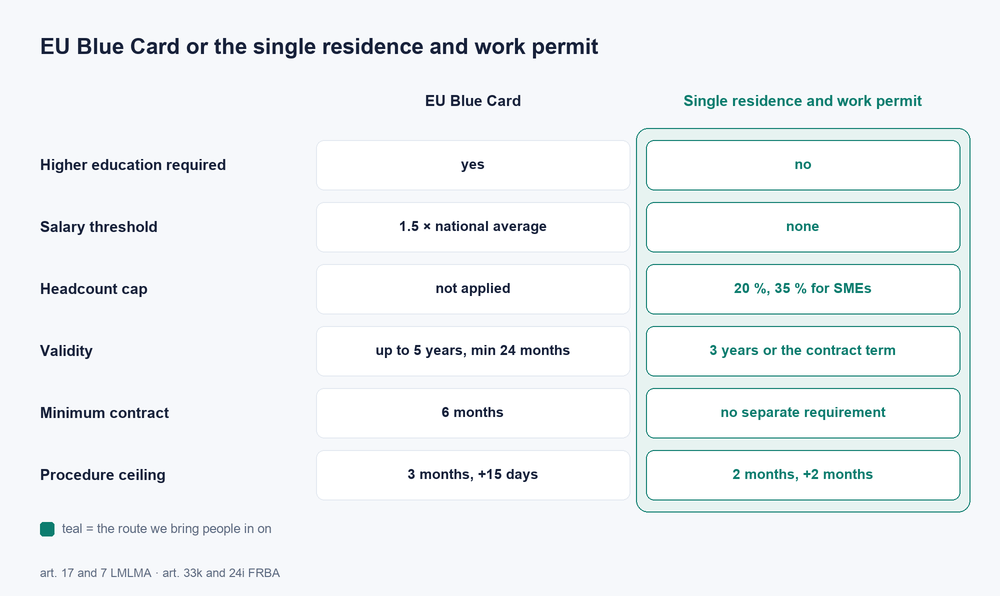
For manual and skilled trades the route is the single residence and work permit. It runs for three years or for the term of the contract, it goes through the same Migration Directorate and the same opinion from the Employment Agency, and it carries the headcount cap the Blue Card avoids: third-country nationals up to 20 per cent of the average payroll, or 35 per cent in a small or medium enterprise.
For a trade the right-hand column applies, and it is the only one of the two we work with.
The route is written out step by step, with every statutory deadline, on the page about the work permit and its timing. What the Employment Agency checks about your company before it gives an opinion, and what you owe once the person starts, is on the page about employer obligations.
We do not work with the Blue Card and we will not offer it to you. We bring people in on the single permit: construction and finishing, transport, manufacturing, warehousing, kitchens and hotels. If the post you are filling is highly qualified, this page should have saved you a month of reading. If it is a trade, describe the job and the site and say how many people it needs, and you will have an answer within 48 hours in business hours. Everything that happens in Uzbekistan before a single form is filed in Bulgaria is what we prepare on the sending side.
FAQ
Questions and answers
Who qualifies for an EU Blue Card in Bulgaria?
A third-country national in highly qualified employment. The act asks for higher education from a course of at least three academic years, or at least three years of relevant experience within the last seven in a post requiring higher education for managers and specialists in information and communication technologies, or at least five years of such experience for any other post. All three conditions of art. 17(2) of the Labour Migration Act apply together.
What is the minimum salary for a Blue Card in Bulgaria?
At least 1.5 times the national average wage according to the latest published data of the National Statistical Institute for the 12 months before the contract is signed. In the second quarter of 2026 the average was 1 444 euro, which puts the threshold at about 2 166 euro gross per month. The exact figure depends on the date of the contract and on the latest release.
Does the headcount cap on third-country staff apply to the Blue Card?
No. Art. 17(1) of the Labour Migration Act says the condition in art. 7(1)(1) is not applied, so the 20 per cent limit, or 35 per cent for small and medium enterprises, is lifted. The other two conditions of art. 7(1) stay: pay and conditions no less favourable than for Bulgarian nationals, and real qualification for the post.
Can a welder, a driver or a bricklayer get an EU Blue Card?
No. Experience counts only where it was gained in a post that itself required completed higher education, which excludes manual trades however long the record is. The salary threshold puts the same answer in numbers: 2 166 euro gross is 1.83 times the average wage in Bulgarian construction and 2.42 times the average in hotels and restaurants. For these occupations the route is the single residence and work permit.
Get in touch
Let's discuss your staffing needs
Leave a request and we'll get back to you within 48 hours during business hours — or reach us directly on Telegram or by phone.