Work permit in Bulgaria for employers: which one, and how long
Which of Bulgaria's four permits your job needs, and how the single permit runs: every statutory deadline from filing to the card, and what to have ready before you file.
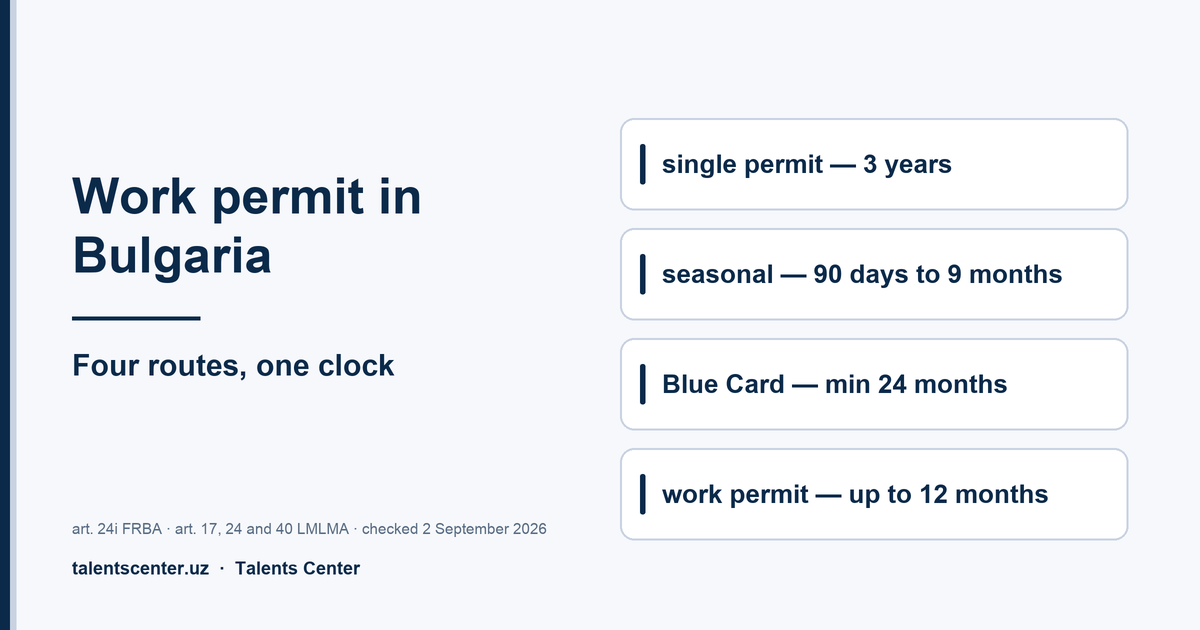
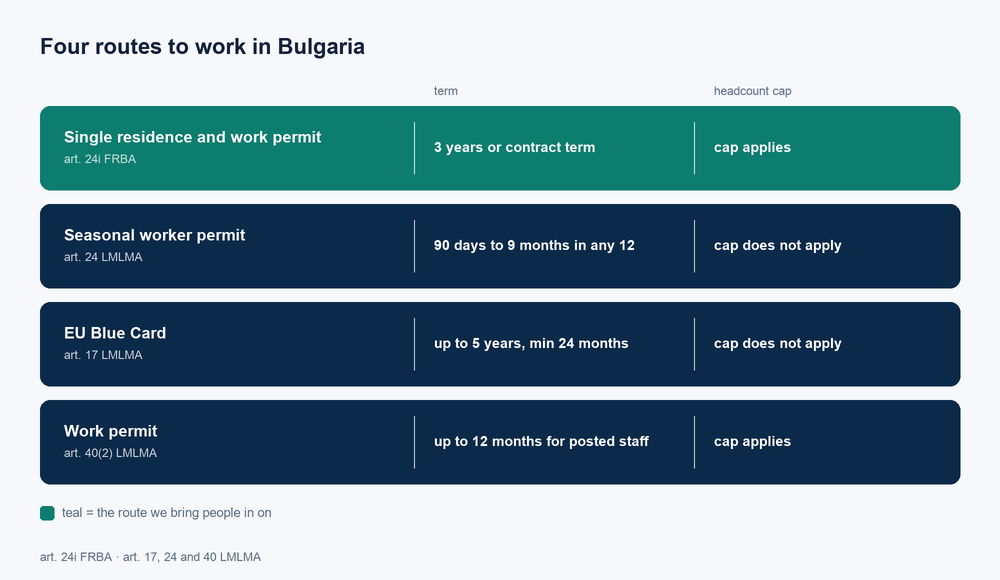
There is no single work permit in Bulgaria for employers to apply for. There are four routes, and which one you need depends on the job, not on the person. For an ordinary job under a Bulgarian contract the document is the single residence and work permit, and the law caps that procedure at two months.
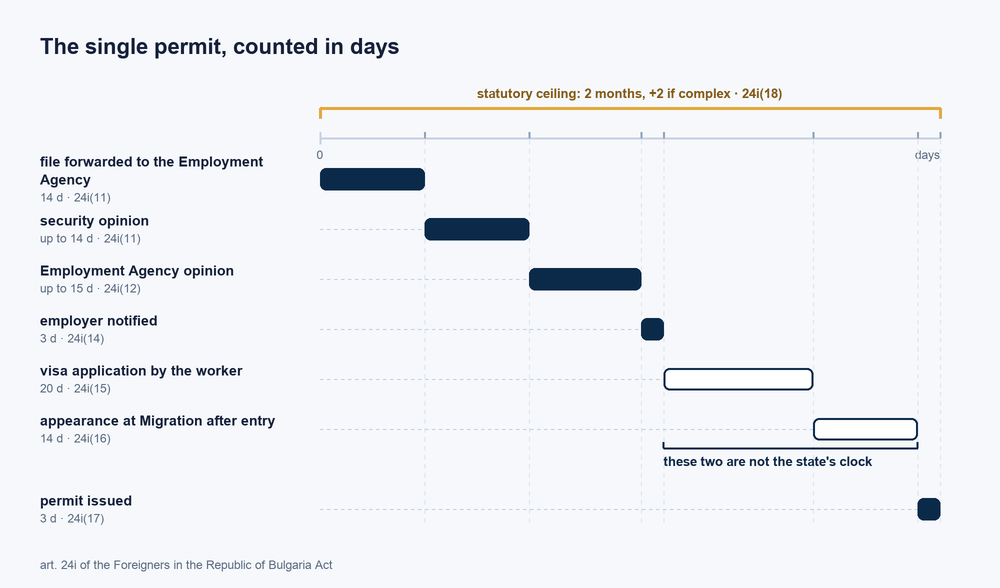
Inside those two months every step has its own deadline — and most of them belong to the state, not to you. This page walks the route in days, from the counter where the file is handed in to the day the person can start.
Every deadline below was read on 2 September 2026 in the current text of the Foreigners in the Republic of Bulgaria Act, in the copy the National Employment Agency publishes. The apostille section comes from the Hague Conference status table, read on the same day.
Work permit routes in Bulgaria: which one the employer files
Route
When it applies
Who decides
How long it runs
Headcount cap
Single residence and work permit, art. 24i FRBA
ordinary job under a Bulgarian employment contract
Ministry of Interior, after a written opinion of the Employment Agency
3 years, or the term of the contract if shorter
applies
Seasonal worker permit, art. 24 LMLMA
agriculture, forestry and fishing; hotels and restaurants
same
90 days to 9 months in any 12
does not apply
EU Blue Card, art. 17 LMLMA
highly qualified post
same
up to 5 years, never under 24 months
does not apply
Work permit, art. 40(2) LMLMA
posted or seconded staff, some family members, cases outside the chapter
Executive Director of the Employment Agency
up to 12 months for posted staff
applies
The job decides the route, and only two of the four lift the headcount cap.
The fourth row is the one that causes confusion, because English-language pages often call every Bulgarian document a "work permit". Only the fourth row is a work permit in the strict sense of the law. It is also the only route with a fee named in the migration act itself: BGN 400 to issue or extend it, BGN 200 to reissue a lost one, under art. 41(5) and (6) of the Labour Migration and Labour Mobility Act.
If you are hiring a bricklayer, a driver or a cook on your own payroll, your row is the first one. The rest of this page is about that row.
The single permit, counted in days
The employer files the application under the Foreigners in the Republic of Bulgaria Act at the Migration Directorate, or at a Migration department at a regional directorate of the Ministry of Interior. From there the file moves on a schedule.
Step
Who acts
Deadline
Where it is written
Regional unit sends the file on, originals to follow
Ministry of Interior
at once, originals within 3 days
art. 24i(8)
Missing papers are requested
Migration Directorate
you get 7 days, then the case is closed
art. 24i(9) and (10)
File reaches the Employment Agency
Migration Directorate
within 14 days of filing
art. 24i(11)
Security opinion
State Agency for National Security
up to 14 days
art. 24i(11)
Labour market opinion
Employment Agency
up to 15 days, and the clock stops while papers are missing
art. 24i(12)
Employer is told that access is granted
Migration Directorate
within 3 days
art. 24i(14)
Worker applies for the long-stay visa
worker, prompted by you
within 20 days of that message
art. 24i(15)
Employer and worker appear at Migration after entry
employer
within 14 days of entry
art. 24i(16)
Permit issued or refused
Migration Directorate
within 3 days
art. 24i(17)
Seven statutory deadlines inside a two-month ceiling, and two of them are not the administration's to keep.
The ceiling on all of it is two months, and it can be extended by two more months where the case is factually or legally complex. That is art. 24i(18), and it is the number most quoted to employers.
Notice the wording of the sixth row. The Agency has fifteen days, but the clock stops while a document is missing. A complete file runs on the schedule in the table. A file short of one translation can wait a month with no deadline broken. That is the argument for having the papers assembled by people who do it every week: completeness on day one is what decides whether the two-month ceiling means anything at all.
Read the two deadlines in the middle of the table again. The 20 days after the notice belong to the worker, who has to book a visa appointment at a Bulgarian consulate abroad. The 14 days after entry belong to you. Neither sits inside the state's two months in any useful sense. A consular queue is not a Bulgarian administrative deadline, and nobody at the counter will remind you that day nine of fourteen has passed.
One more thing the ceiling does not cover. It starts when a complete file reaches the counter. Everything that makes the file complete happens earlier, and in another country.
What has to be ready before anything is filed
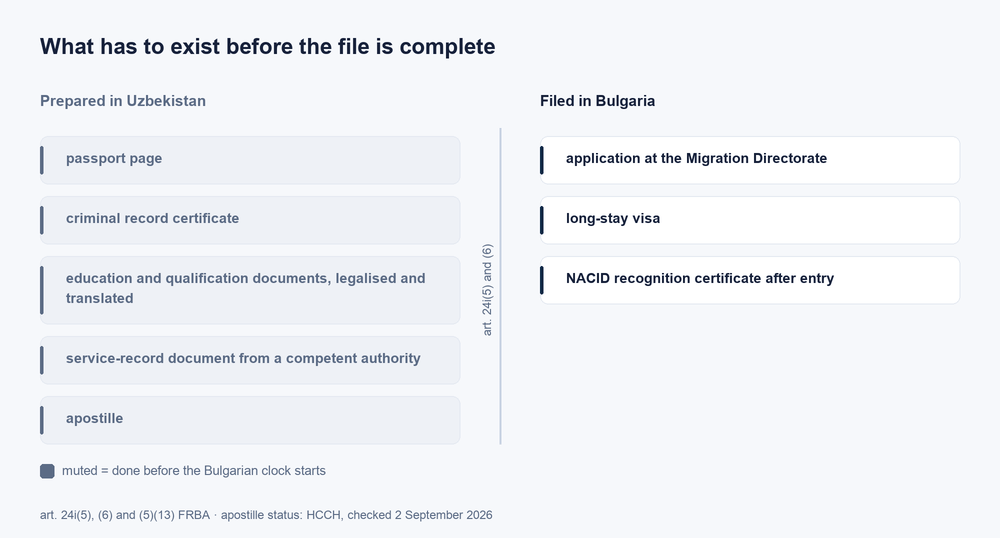
Art. 24i(5) lists what goes with the application. Five items on that list can only be produced where the worker lives:
a copy of the passport page with the photograph and personal data;
a criminal record certificate from the state of nationality or of habitual residence, on a first application;
documents on education, speciality, licence, professional qualification and experience, legalised in the proper form, with a certified translation into Bulgarian, matching the requirements for the post under the 2011 National Classification of Occupations;
proof of skills and experience in a specific shape: art. 24i(6) asks for a service-record document issued by a competent authority of that state, naming the employer, the length of service and the post held;
since the 2025 amendment, a certificate from the National Centre for Information and Documentation recognising higher education obtained abroad, filed after the person enters on a long-stay visa.
The fourth item is the quiet one — the one that stops files. A reference letter from a former employer is not what the article asks for. It asks for a document from a state body. In most countries that document has to be requested, waited for and then legalised like any other, and a group moves at the speed of its slowest file.
Legalisation is where the sending country stops being an abstraction. For Uzbekistan it is simpler than employers expect. Both states are parties to the 1961 Hague Apostille Convention: Bulgaria since 29 April 2001, Uzbekistan since 15 April 2012. An apostille is enough, and no consular legalisation is needed between them.
That is not true everywhere. Four states objected to Uzbekistan joining, so the convention never entered into force between them: Germany, Austria and Greece, plus Belgium, which withdrew its objection on 11 June 2025. Bulgaria never objected. The same diploma with the same apostille is accepted in Sofia and refused in Berlin, Vienna and Athens. If you also staff sites in Germany or Austria, that difference is worth checking before you copy a Bulgarian document pack across the border.
Five of the eight documents are produced in the worker's own country, and none of them is on the administration's clock.
This is the half of the job that sits with us. We prepare the file on the Uzbek side: the service records, the criminal record certificates, the diplomas and their legalisation, and the interviews behind them. What we prepare and what stays with you is set out on our page for employers in Bulgaria.
Validity, and the date to put in the calendar now
The permit runs for three years, or for the term of the contract when the contract is shorter. That is art. 24i(2), and it means a two-year contract produces a two-year permit rather than a three-year one.
For a renewal the person does not have to leave the country, and does not have to be outside it at first application either if residence is already permitted. Art. 24i(3) says so in one sentence, and it removes a trip that employers still plan for.
The date to write down is the deadline for the next application: not later than two months before the current long-stay residence permit expires, under art. 24i(4). Two months is also the ceiling on the procedure. Filing on the last allowed day leaves no margin, and the extension in art. 24i(18) eats exactly that margin.
What this page leaves to other pages
Three questions sit outside this route on purpose, and each has its own page.
Whether your company passes the checks before any of this starts is a separate matter, and so are the duties that begin on the worker's first day. Both are on the page about what Bulgaria checks about the employer. If the job is tied to the season, the route above is not yours at all: seasonal work has its own list of sectors and its own, shorter clock. And if someone has recommended the EU Blue Card as the quick way round the headcount cap, read that page before you plan around it.
If you already have a start date in mind, plan backwards from it rather than forwards from today. Write to us with the trade, the number of people and the month you need them on site, and we will send back the Uzbek documents each person has to collect and the order to collect them in. The reply comes within 48 hours in business hours.
FAQ
Questions and answers
Which Bulgarian permit does an ordinary hire need?
The single residence and work permit under art. 24i of the Foreigners in the Republic of Bulgaria Act. The Ministry of Interior issues it after a positive written opinion from the Executive Director of the National Employment Agency, and it is valid for three years or for the term of the employment contract if that is shorter. The seasonal permit, the EU Blue Card and the work permit under art. 40(2) of the Labour Migration and Labour Mobility Act cover other situations.
How long does the single permit procedure take by law?
Art. 24i(18) caps it at two months, extendable by two more months where the case is factually or legally complex. Inside that ceiling the file has to reach the Employment Agency within 14 days, the Agency has up to 15 days for its opinion, and the permit is issued within three days of the last documents being presented. The ceiling starts when a complete file is filed, not when you decide to hire.
Who files the application, the employer or the worker?
The employer, or a person authorised by the employer. The worker may file in person only where they already hold a long-stay residence permit, and even then the employer signs the application. That is art. 24i(4) of the Foreigners Act.
Does a diploma from Uzbekistan need consular legalisation for Bulgaria?
No. Both countries are parties to the 1961 Hague Apostille Convention, Bulgaria since 29 April 2001 and Uzbekistan since 15 April 2012, so an apostille is sufficient and consular legalisation is not required. The document still needs a certified translation into Bulgarian. Germany, Austria and Greece objected to Uzbekistan joining the convention, so the same apostille does not work for them.
Get in touch
Let's discuss your staffing needs
Leave a request and we'll get back to you within 48 hours during business hours — or reach us directly on Telegram or by phone.