Seasonal workers in Bulgaria from third countries: two routes
Two sectors only, two routes, one order that names them. Registration up to 90 days, a permit from 90 days to nine months, and three costs the employer carries by law.
Seasonal workers in Bulgaria from third countries can be hired in two ways, and the choice is made by the length of the season rather than by the job. Up to 90 continuous days the employment is registered on a declaration by the employer. From 90 days to nine months it needs a seasonal worker permit, which the Ministry of Interior issues after a written opinion from the Employment Agency.
Both routes are open only to two economic sectors. If your activity is not in one of them, the seasonal regime is closed to you no matter how seasonal the work feels.
The sector list was read on 2 September 2026 from the scanned original of Order RD-01-47 of 17 January 2017. The deadlines come from the current texts of the two migration acts, and the employment figures from the National Statistical Institute.
Two sectors, and the order that names them
Art. 25(1) of the Labour Migration and Labour Mobility Act tells the Minister of Labour and Social Policy to approve a list of economic sectors whose activities depend on the change of seasons. The list is drawn up once, after consultation in the National Council on Labour Migration and Labour Mobility, and the European Commission is notified of it.
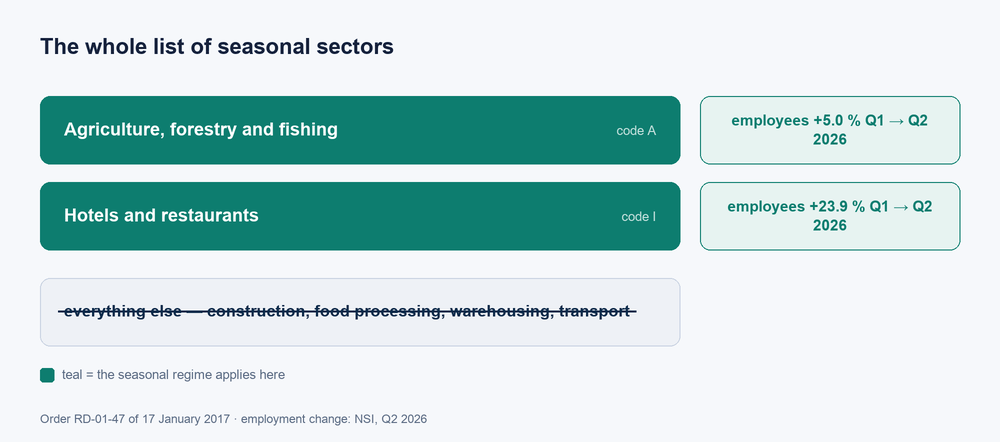
The list in force was approved by Order RD-01-47 of 17 January 2017. It has exactly two rows:
agriculture, forestry and fishing, code A of the 2008 classification of economic activities;
hotels and restaurants, code I.
Two sectors is the entire list, and they are also the two where employment jumps hardest between spring and summer.
The two rows are not an arbitrary pick, and the national statistics say so every summer. Between the end of March and the end of June 2026 the number of employees in Bulgaria grew by 14.8 thousand overall, and the two largest increases were in hotels and restaurants, up 23.9 per cent, and in agriculture, forestry and fishing, up 5.0 per cent. Those are the same two sectors, in the same order, and no third activity comes close.
Construction is not on it. Neither is food processing, warehousing or transport, and none of them becomes seasonal by having a busy summer. Art. 25(4) gives access under the seasonal route only for activities included in the list, so the sector question is settled before any document is prepared.
The order is published as a one-page scan of the signed original, with no text layer, so no search engine and no translation tool can read what is inside it. Open it anyway. The approved list of economic sectors settles the sector question in two printed lines, and that is the whole document.
Up to 90 days: a registration, not a permit
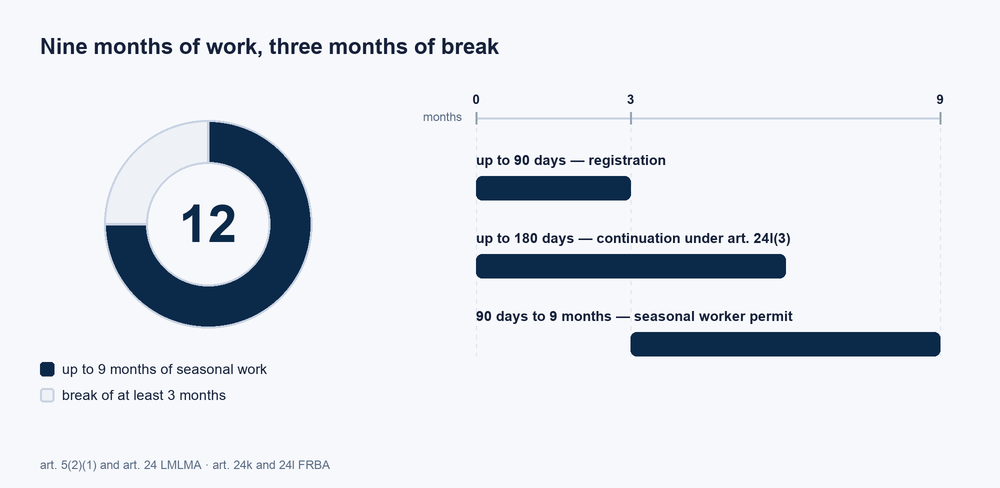
Art. 24(2) of the Labour Migration Act registers seasonal work of up to 90 continuous days in any 12-month period on the basis of a declaration filed by the employer. There is no permit and no opinion procedure. The Agency's own description of the procedure puts the registration at within 10 days of the declaration being filed, confirmed by an endorsement on the declaration and a certified copy returned to the applicant.
Since the 2025 amendment there is a faster version of this. Art. 24(3) provides an accelerated registration for a person who has done seasonal work of up to 90 days in Bulgaria at least once in the previous five years. The same idea runs through the longer route as well, and it is the strongest argument for bringing the same people back.
One limit is easy to miss. The 90 days are continuous, and the registered period cannot be changed or extended. What the law added in 2024 is a different thing: art. 24l(3) of the Foreigners Act lets the person carry on with the same employer, or move to another one, for up to 180 consecutive days within 12 months of the first registration, without leaving the country and without a long-stay visa. The application goes in 30 days before the lawful stay runs out, with the documents listed in art. 24k(8).
The Agency's English-language description of its procedures still says that the legislation provides no possibility to change or extend a registered seasonal period. That was written before the 2024 amendment and we checked it again on 2 September 2026. The registration itself indeed cannot be extended. The route to 180 days exists anyway, under a different article and with a different document at the end of it.
Seasonal workers from third countries: the permit for 90 days to nine months
Art. 24(1) of the Labour Migration Act opens this route, and art. 24k of the Foreigners in the Republic of Bulgaria Act runs it. The applicant has to be outside Bulgaria when the employer files, and the permit is issued for the term of the contract: never under 90 days, never over nine months in any 12-month period. It can be extended once inside that nine-month window, with the same employer or a new one.
Step
Deadline
Where it is written
Missing papers are requested
7 days to supply them
art. 24k(10)
File reaches the Employment Agency
within 14 days of filing
art. 24k(12)
Security opinion
up to 14 days
art. 24k(12)
Employment Agency opinion
up to 10 days, or 5 days for a returning seasonal worker
art. 24k(13)
Employer is told access is granted
within 3 days
art. 24k(16)
Worker applies for the long-stay visa
within 20 days of that message
art. 24k(17)
Employer and worker appear at Migration after entry
within 7 days of entry
art. 24k(18)
Permit issued or refused
within 3 days
art. 24k(19)
Whole procedure
not longer than 2 months
art. 24k(22)
The break is not a formality; it is what the law uses to keep the worker seasonal.
Compare two of these lines with the ordinary route and the season starts to look manageable. The Agency has 10 days here instead of 15, and 5 days for someone who has worked a Bulgarian season in the last five years under art. 24k(5). After entry you have seven days to appear rather than fourteen. The seasonal calendar is unforgiving, and the law has been written with that in mind.
The headcount cap does not apply on this route. Art. 24(1) says the condition in art. 7(1)(1) is not applied, and art. 25(4) repeats it for the sector list. The other two conditions of art. 7(1) stand, and so does everything a Bulgarian employer owes once the person starts: those are set out on the page about the two gates and the duties behind them.
What the employer pays for, by law
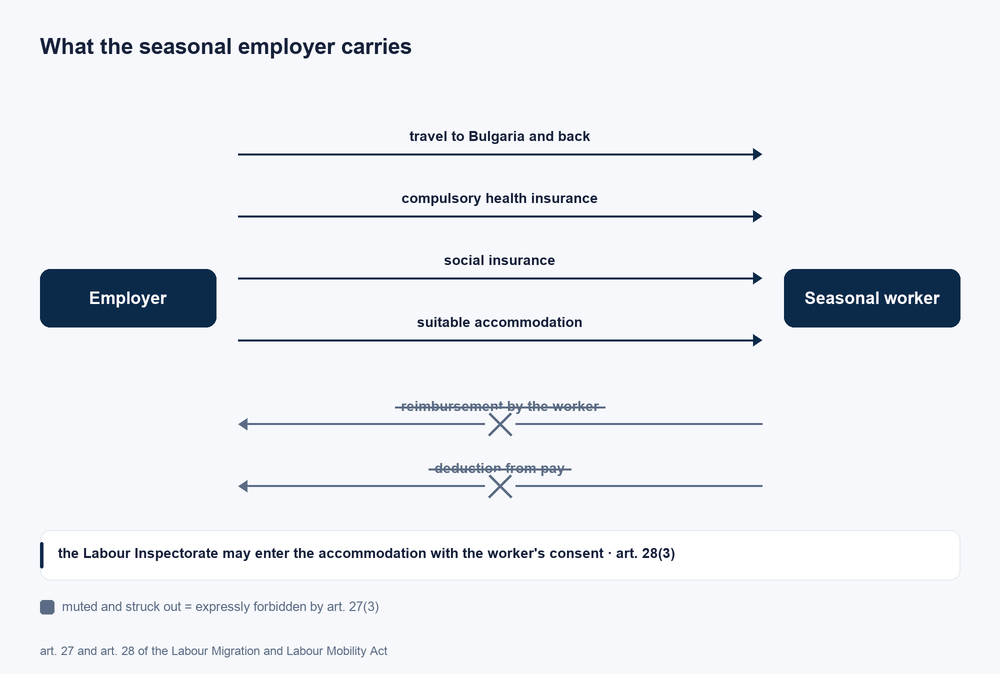
Three costs sit with the employer on the seasonal route and nowhere else. They are not negotiable and they cannot be recovered from the worker.
Art. 27 puts the travel from the seasonal worker's place of origin to the workplace in Bulgaria on the employer, and the journey back as well. The same article puts the compulsory health insurance and social insurance on the employer. It then says in as many words that neither cost is repaid to the employer by the worker and neither may be deducted from the worker's pay.
Art. 28 adds accommodation. The employer provides suitable housing that meets all health and safety requirements, or arranges it, until the contract ends. Where there is a lease, the rent has to be in line with the worker's pay and with the quality of the housing, and it is not deducted from the pay automatically. The General Labour Inspectorate may enter that accommodation to check, with the worker's consent.
Four costs go one way only, and the act says so in as many words.
Put together, these three lines are the real price of the seasonal regime, and they are the reason it comes without a headcount cap. Bulgaria is not making seasonal hiring cheaper — it is making it faster and putting the logistics on the employer.
Nine months, then a break
Art. 5(2)(1) closes the year. Once the maximum of nine months in any 12-month period has been reached, new access to the labour market for the same person requires a break in employment of at least three months.
Nine plus three is twelve, and that is the design. A seasonal worker is a person who keeps a main residence in a third country and comes for the season, and the break is what keeps that true. For an employer planning two seasons in a row, the break is a date to put in the plan rather than a surprise to discover in month ten.
We work with the two sectors on the list, on both the short and the long route, and the permit route with its full set of deadlines is written out separately for the year-round jobs. Write to us with the sector, the size of the crew and the weeks you need them on site. Within 48 hours in business hours you will know what group we can put together for that window, and which people in it have worked a Bulgarian season before, because for those the Agency's clock is five days instead of ten. Before you write, it is worth reading where our work ends and yours begins.
FAQ
Questions and answers
Which sectors may hire seasonal workers in Bulgaria?
Two, and only two: agriculture, forestry and fishing (code A of the 2008 classification of economic activities) and hotels and restaurants (code I). The list was approved by Order RD-01-47 of 17 January 2017 of the Minister of Labour and Social Policy, and art. 25(4) of the Labour Migration Act gives seasonal access only for activities on it. Construction, food processing, warehousing and transport are outside it.
What is the difference between the 90-day registration and the seasonal permit?
Up to 90 continuous days in any 12-month period the employment is registered by the Employment Agency on a declaration from the employer, with no permit and no opinion procedure. From 90 days to nine months in any 12-month period the Ministry of Interior issues a seasonal worker permit after a written opinion from the Employment Agency, and the worker must be outside Bulgaria when the employer applies.
Can a seasonal worker stay longer than 90 days without leaving Bulgaria?
Since 2024, yes. Art. 24l(3) of the Foreigners Act allows the person to continue with the same employer or move to another one for up to 180 consecutive days within 12 months of the first registration, without leaving the country and without a long-stay visa. The application goes in 30 days before the lawful stay expires. The 90-day registration itself still cannot be extended.
Who pays for a seasonal worker's travel and accommodation in Bulgaria?
Art. 27 and art. 28 of the Labour Migration and Labour Mobility Act put these costs on the employer, and this is a statutory duty rather than a matter of custom or negotiation. Art. 27 covers travel from the worker's place of origin to the workplace and back, the compulsory health insurance and the social insurance, and states that these costs are not repaid by the worker and may not be deducted from pay. Art. 28 requires suitable accommodation meeting all health and safety requirements until the contract ends; where there is a lease, the rent must match the pay and the quality of the housing.
Get in touch
Let's discuss your staffing needs
Leave a request and we'll get back to you within 48 hours during business hours — or reach us directly on Telegram or by phone.