Facade fitter
Facade insulation and finishing, including work at height.
Open
How to hire foreign workers in Croatia: which trades skip the labour market test, how many Croatian staff you need first, and what we prepare in Uzbekistan.
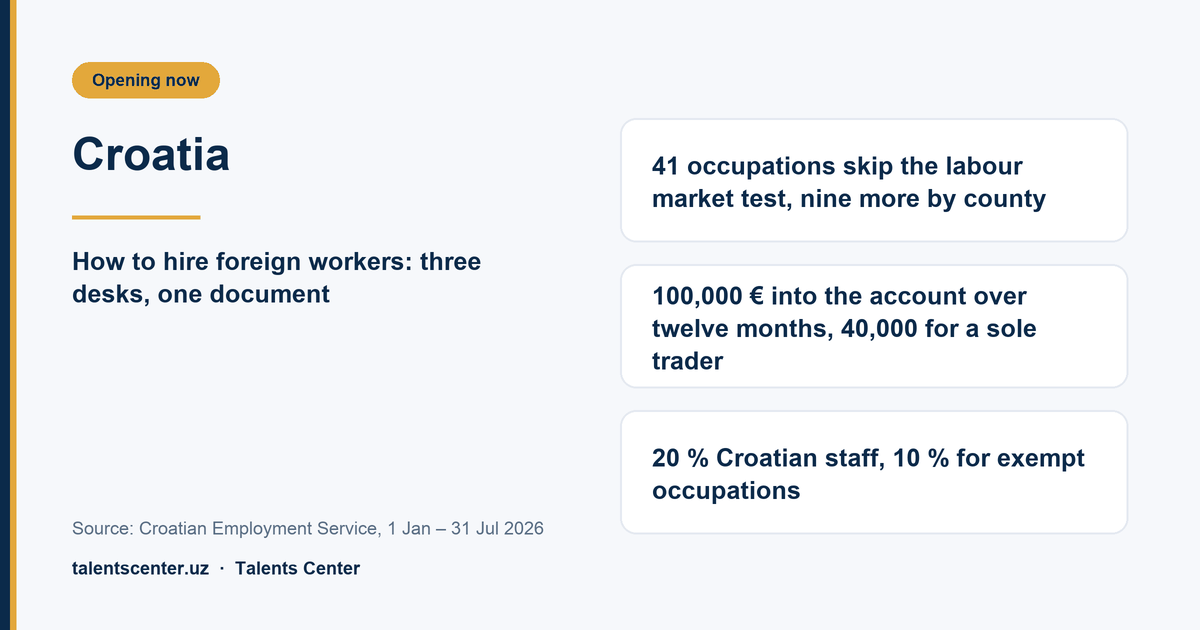
How to hire foreign workers in Croatia runs through three desks, not one. The employment service checks whether anybody already in the country can do the job, then sends the police administration a written opinion about you, the employer. Only after that comes the single document covering residence and work.
English-language guides stop at the first desk. The Croatian numbers say the second one is where hiring fails.
Croatia is a new destination for us, opening now for construction and manufacturing. The Croatian side comes first here; ours at the end.
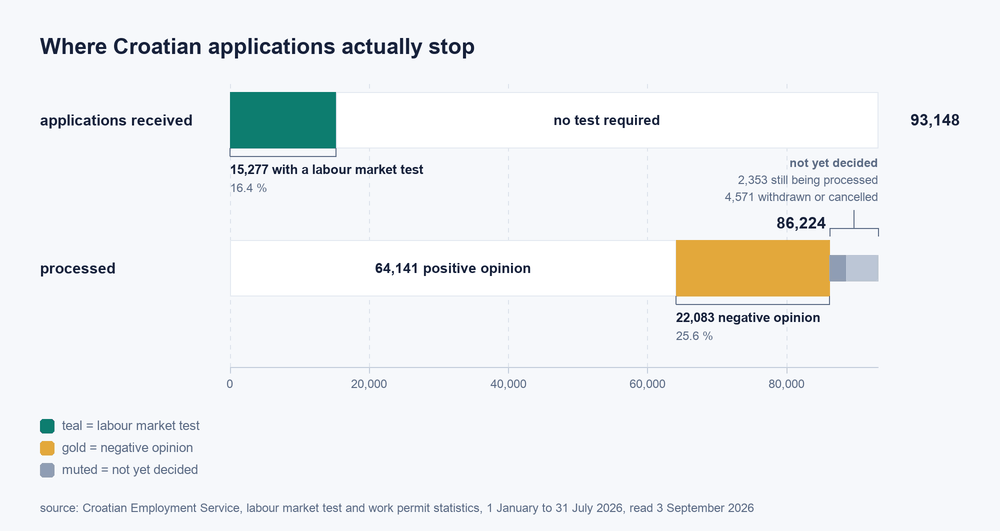
Between 1 January and 31 July 2026 the Croatian Employment Service received 93,148 applications for an opinion. The service's own statistics show that only 15,277 carried a labour market test. One in six.
Article 101 of the Aliens Act is why. It lets the service's governing board publish a list of occupations for which no test is required at all, and obliges the board to amend it without delay. The published list holds 41 occupations valid in every county, plus nine limited to named ones.
The 41 show the shape of Croatian demand: bricklayer, carpenter, steel fixer, welder, facade fitter, crane operator, roofer, plumber, electrician, tiler, building labourer. None of the nine county-limited entries is a building trade: they are waiters, cooks, room attendants, cleaners, a garment machinist, a bus driver and a shop assistant allowed only from May to September.
Where a test is required, the service answers within 15 days, and you then have 90 days to file.
Of the 86,224 applications processed by 31 July, 22,083 came back negative. Another 2,353 were in processing and 4,571 withdrawn. Worse than one in four. The test did not produce them; article 99 did.
Since 4 June 2026 the service gives a positive opinion only if your full-time Croatian, EEA or Swiss staff amount to at least 20 per cent of your third-country headcount. For an occupation on the exemption list the figure is 10 per cent. Opinions already granted to you count towards the third-country side of the next application, so the ratio tightens as you hire.
Five Croatian full-timers carry 25 third-country workers at 20 per cent, or 50 at 10 per cent. Do that arithmetic before anyone books a visa. If it does not come out, send us your split now rather than after a refusal.
The same amendment added two money tests: at least 100,000 euro received into the employer's account over twelve months, or 40,000 for a sole trader, and no block on that account longer than 30 days in a row in the previous six.
Consolidated versions of the act still in circulation print the old thresholds of 16 and 8 per cent and a monthly turnover of 10,000 euro. Those were replaced on 4 June 2026. Read the amending act, not a consolidation.
One document covers residence and work, tied to one employer, one occupation and one territory. The territory part is new. A worker for whom a test was run may work only in the area of the police administration that ran it; a worker in an exempt occupation, only where that occupation is short. A test can now be requested for several administrations at once, the fix for a company with two sites.
The police administration decides within 90 days of a complete application, and that period includes the test itself. Exceptional circumstances add 30 days.
In the first seven months of 2026 the Ministry of the Interior issued 106,395 residence and work permits. Construction took 27,172 of them. Uzbekistan stands seventh by citizenship with 4,524.
The trades we are opening in Croatia come in two groups. Tilers, plasterers, painters, bricklayers, facade fitters and formworkers on one side; MIG/MAG welders, turners and millers on the other. No drivers, no hotel staff.
Our licence is Uzbek, and checking it takes a minute. The state register of private employment agencies of Uzbekistan carries us under the company name, LLC "Specialist Group Private Employment Agency", entry 0078 of 7 April 2021. Searching it for the words Talents Center returns nothing — that is only the trade name. Our office is in Andijan.
Article 97 wants proof of competence for an occupation from the article 101 list, shown by experience or by education. That document comes from our end, with the criminal record certificate, the medical, the legalised diploma and the visa appointment Uzbek nationals need. Nobody reaches your file without our interview.
Bulgaria is where we have worked longest; the employer page for Bulgaria says what five years look like. Croatia is at the start, and saying so beats being caught out.
Write to us with the trade and the county. We come back inside 48 hours in business hours with two things: how many people we can have ready for that job, and which Croatian steps nobody can take off your desk.
Facade insulation and finishing, including work at height.
OpenWalls and partitions. One of the trades we place in both Bulgaria and Croatia.
OpenErecting and striking formwork on cast-in-place structures. Site experience required.
OpenLevelling walls and ceilings for paint and wallpaper, interior finishing.
OpenWalls, ceilings and steelwork, interior and exterior.
OpenTile and porcelain stoneware in washrooms, kitchens and public areas.
OpenSemi-automatic welding in shielding gas. We place welders in both Bulgaria and Croatia.
OpenLathe and milling machines, drawing reading and dimensional control.
OpenThe occupations named in the decision of the employment service's governing board under article 101 of the Aliens Act. Its published file lists 41 of them valid across every county, including welder, tiler, roofer, electrician, plumber, crane operator, bricklayer and carpenter, and nine more restricted to named counties. The board must revise that decision without delay, so read the file on the service's own site rather than a second-hand summary.
From 4 June 2026 a positive opinion depends on your existing staff. Croatian, EEA or Swiss employees on full time have to reach at least 20 per cent of the number of third-country workers you employ, and 10 per cent where the occupation is on the exemption list. Five domestic full-timers therefore support 25 third-country workers, or 50 in an exempt occupation. Opinions already issued to you are counted in as well at the next application.
Only where the test was carried out, meaning the territory of that single police administration. If the occupation is exempt, the limit becomes those administrations in which it counts as short. One request can cover several of them, and whichever are covered appear on the certificate issued with the permit.
That the direction is opening now, for building and manufacturing trades, and that we are not claiming placements there. What we do have is the sending end: an Uzbek licence, our own screening and interviews, and the paperwork behind a residence and work permit application. Bulgaria is the market with five years of our work behind it.
Write with the occupation and the county. We will tell you whether it sits on the exemption list, and how many people your current staff ratio allows this year.
Contact us